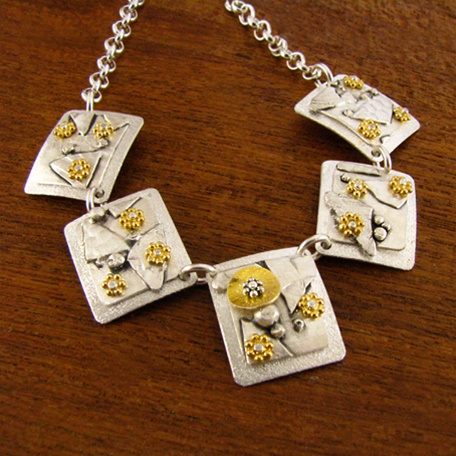
How do you determine correct ring size without someone knowing?

Are you thinking about a surprise proposal, but aren’t sure how to determine the correct ring size without your sweetheart knowing? Here are a few tips for getting a ring size on the sly:

how to determine the correct ring size without someone knowing

1: Go Shopping! Ask your mate to go shopping and help you find a ring for your friend (or sister, brother, mother, father, etc), under the guise that you think the recipient and your mate probably have the same size fingers. Make sure to have the rings sized as you shop, and don’t forget to write down the correct ring size!

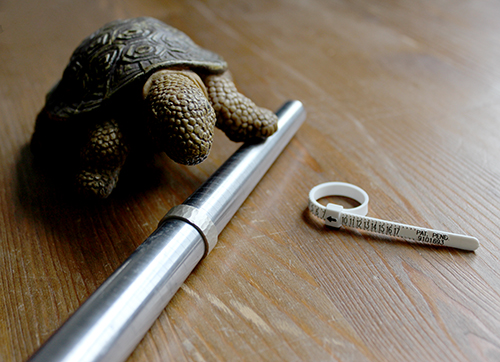
2: Measure an existing ring! If your sweetheart already owns a ring that fits, you can take it to a jeweler to be measured. You can also find a printable ring size chart, where you can simply line up the existing ring with the corresponding circle to get the correct ring size.

3: Ask a friend for help! If the above methods seem to difficult or obvious, try enlisting the help of a trustworthy friend. Often a close friend will know just how to extract the necessary information, whether it’s through shopping or casual conversation.

Just remember, at Turtle Love Co almost any ring can be resized if it’s not a perfect fit. And if you’re not trying to surprise some one, we’re also happy to send you a free ring sizer.


Vintage Ringspiration

One of my favorite jobs at Turtle Love Co. is creating the listings for our vintage rings. I get to photograph and describe beautiful works of art made from metal and stone – little round symbols of love and commitment – and make them as stunning on your computer screen as they are in person using imagery and words.

As much as I love to photograph, I think my favorite thing to do is name the pieces. The first batch of rings I got to name, I named after members of my family. The recently sold Paulina, one of my favorites, is named for a variation of my mother’s middle name, Pauline. The Josephine was named after my husband, Joe. The Lucille is named after my aunt, and Rochelle is my cousin’s middle name.

For the next batch, I decided to use the names of some of my favorite women in music. Regina is named for Regina Spektor, Joan for Joan Jett, Etta for Etta James. I love to match the names I have in mind to the style and feel of each ring.

I decided to use this blog entry as an opportunity to preview three of twelve new vintage rings I’ve currently named and will be putting up on the site within the next week or so. This time around, the names are based on female fine artists throughout history.
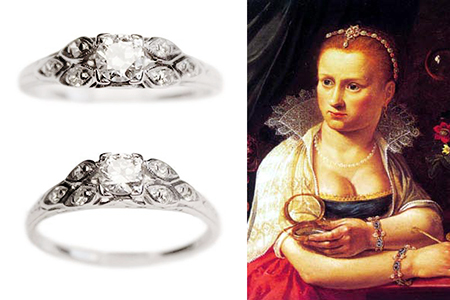
We’ll go in chronological order, beginning with the Clara. The Clara Vintage Diamond Engagement Ring is named after Clara Peeters, a Flemish painter born in 1594. You may have never heard of her because, like most other remarkable women in history, the fact that she was a woman prevented her from being as renowned as she should have been. But her work speaks for itself – the way she was able to render details in her still-life and floral paintings is truly remarkable. I chose Clara for the name of this ring because of its exquisite detail and floral motif.
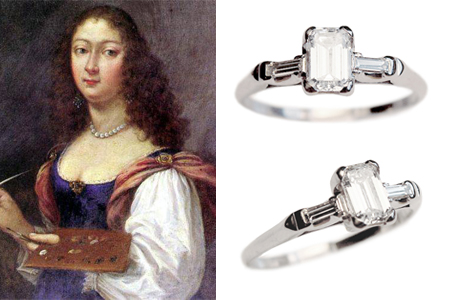
Next up is the Elisabetta Diamond Vintage Engagement Ring, named for Elisabetta Sirani, an Italian Baroque painter born in 1638. Sirani died young, at only 27 years of age, but her breadth as an artist is remarkable. She had completed almost 100 works of art by the time she was 17, and doubled that amount by the time she died. Like many Italian Baroque painters, many of her works were very large in scale and used a lot of Christian imagery. What is most remarkable is that this young woman supported her parents and her siblings with her artwork. I chose Elisabetta as the name for this ring because of its simple, strong, and elegant presence.
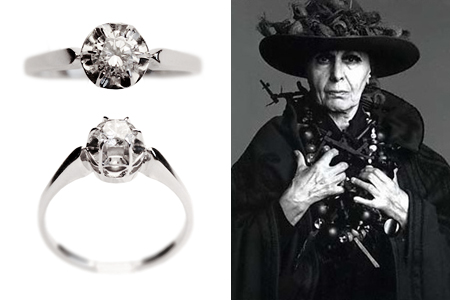
Lastly, we skip a few hundred years to the Louise Vintage Diamond Engagement Ring, named for Louise Nevelson. Nevelson, a modern American sculptor, was born in Russia in 1899 and moved to the United States (Maine, even!) at age 6. Nevelson is known for her large-scale wooden wall pieces and outdoor sculptures, and was first inspired to be an artist when she saw a sculpture of Joan of Arc at age 9. Nevelson believed that art should be an expression of the individual, and not something that should be categorized as masculine or feminine. Her pieces were large, dark and intimidating – against the grain for a female artist. She is revered as a pioneer in the feminist art movement for her ideals and her unique artistic vision. I chose Louise as the name for this ring based on its tall, sculptural quality and commanding presence.

Other artists I’ve named rings after in this upcoming batch are Mary Cassatt, Frida Kahlo, Georgia O’Keeffe, Lavina Teerlinc, and Mariette Robusti, to name a few. Make sure to check our site regularly for new vintage rings – you may even be able to guess which remarkable women the rings are named after.

A Case for the Unconventional - Alicia

Engagement rings and wedding bands have long been a custom in Western culture. They date back to ancient Egypt, when it was believed that a ring’s circular shape was a symbol of endless love, and that the opening was a gateway to the events of a life spent together. The ring would be placed on the fourth finger of the left hand – believed to contain what the Romans eventually named the “vena amoris,” or “vein of love” - connecting straight to the heart.

It sounds romantic and all, but marriage has had a rockier past than this little tidbit of history would lead you to believe. Throughout the better part of the past 2000 years, Western marriage was more of a contract for the ownership and control of women than a celebration of love and partnership. As a woman, and a feminist to boot, it can be difficult to fully appreciate the custom.

Fortunately for me, my fellow lady folk, and really anyone who one day wants to marry, while the symbol of engagement and wedding rings remain, the rules of Western engagements and marriages have changed significantly. Thanks to people who became fed up with the status quo, marriages are now partnerships, and in more progressive states in the US it’s a custom everyone is allowed to take part in and benefit from.

Part of the reason I’m really digging working at Turtle Love Co. is that our philosophy stresses the importance of creating a more open and inclusive engagement and wedding culture – one that supports equality and personal expression.

Some people don’t believe in marriage because of its less than ideal past, but like any custom, there is always the option to make it your own. Preserve the points of tradition that work for you and leave the rest in the history books. Or even better – you can create your own traditions. The more our marriage experiences vary, the more open the cultural landscape of marriage becomes.

Even the ancient custom of presenting your partner with engagement ring is fully customizable. If you are a vintage and thrift-store maven or antiques aficionado, a vintage engagement ring might be the best match for your personality. If you like the outdoors and all things natural, you’d probably like a band with an organic twist or an eco-friendly and conflict-free ring. If you aren’t fond of diamonds and love a flash of color, a gemstone engagement ring is probably more your style. I’m crazy about purple, so the main stone of my engagement ring is a brilliant cut amethyst – it’s not very traditional, but neither am I.

The point is to choose what makes you happy and what feels right - to not be scared of bending traditions and customs in a way that works for you. Diversity within wedding culture is a beautiful thing - it helps create a more accepting climate and happier, healthier couples.

from commons.wikimedia.org

Okay, so we’re dying to know: what does the modern marriage proposal look like? Who proposes to whom? Is the down-on-one-knee proposal still apropos? In our day-to-day work at Turtle Love Co. we hear from all kinds of couples about their nontraditional wedding ceremonies, not to mention the unique engagement rings and wedding bands so many of them are opting for. With rings that range from the classic to the extraordinary, we suspect that the act of proposing can vary just as much!

Tell us what made your proposal unique. E-mail us at [email protected] with your story (and photos!) if you’d like to be featured in a future blog post. Check back next week to see some responses!

So, what is gold vermeil anyway?

If you read our last post about the new work by Talley & Roberta Starbird (an awesome mother-daughter team from Austin!), you may be wondering about gold vermeil. This method of gold-plating originated in France in 1750 during the reign of Louis XV. This means we say ‘gold vehr-may’ (not to be confused with ‘gold lamé’). To give you some context of the time period that gave rise to gold vermeil, at left is a reproduction of a painting of Louis XV as a kid. Kings started young in those days (he was 5 when he succeeded the throne), when curly, gray wigs were very stylish for the elite and powerful. We’re glad that’s no longer a fashion trend.

So, gold vermeil. If a piece of jewelry is gold-plated, we think it ought to be gold vermeil (sometimes it’s also called ‘gold filled’). It’s the optimal plating technique for its use of only precious metals: 925 sterling silver and a very thin layer of gold (usually 14k and up). This sets gold vermeil apart from other plated metals that may involve covering the silver with nickel or another base metal before the gold goes on. Furthermore, the gold is fused to the sterling silver in such a way that prevents any flaking or chipping of the gold layer. This means that people with sterling silver sensitivities can wear gold vermeil as if it were solid gold, and not worry about skin irritation. So gold vermeil indicates a high-quality, affordable option that will not irritate your skin. That’s what we like.

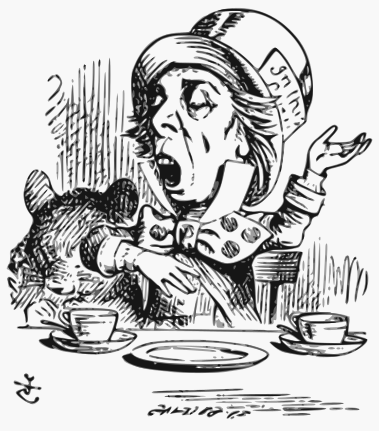
Jewelers in the 18th century used a process called fire-gilding to create gold vermeil. They would apply a mixture of gold and mercury to the surface of the silver, and then expose it all to extreme heat (hence the fire). This caused the mercury to essentially vaporize, leaving the thin film of gold in place. At that time folks didn’t know how toxic mercury was, so it was used in all kinds of professional trades, from metal-smithing to hat making. Breathing in the vaporized mercury resulted in a person going “as mad as a hatter.” (Interesting side-note: Lewis Carroll, the creator of such winsome characters as Alice and the Mad Hatter, grew up in a town where hat making was the main trade in the 1800′s.) Fortunately for everyone, we now know all about mercury’s toxic properties.

Today, gold vermeil is produced using an electrolytic process, which means an electric current is used to create a chemical reaction. We’re not sure how that works, but it sounds cool, and it’s safe for the jeweler. Now that you know all about gold vermeil, you’re probably curious to see it in action. Starbird uses it to great effect in their lovely jewelry, don’t you think?